ARTWRITE #33: THE UNNECESSARY NECESSITY
Dana Sherwood
In Raymond Carver’s short story “A Small, Good Thing,” a couple endure the tragedy of their eight-year-old son dying after he’s hit by a car on his birthday. While dealing with grief and menacing phone calls from the baker about the unpaid birthday cake, the parents confront him, leading to a cathartic moment of connection:
They nodded when the baker began to speak of loneliness, and of the sense of doubt and limitation that had come to him in his middle years. He told them what it was like to be childless all these years. To repeat the days with the ovens endlessly full and endlessly empty. The party food, the celebrations he’d worked over. Icing knuckle-deep. The tiny wedding couples stuck into cakes. Hundreds of them, no, thousands by now. Birthdays. Just imagine all those candles burning. He had a necessary trade. He was a baker. He was glad he wasn’t a florist. It was better to be feeding people. This was a better smell anytime than flowers.
The baker understands the necessity of his trade: to punctuate human celebrations and commemorations. Because he creates these moments for others but rarely experiences them himself, he’s keenly aware of how these rituals bring loved ones together and create memories.
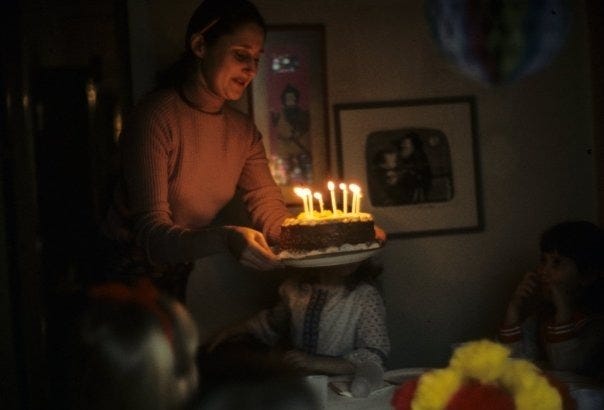
My mother didn’t understand that the pleasure cake provides need not be limited to celebrations. In the photo, she’s smiling as she presents me with a cake from Sinclair Bakery, but I never saw cake—or any dessert—in our home outside of birthdays. Fearful of losing her figure, my mother simply didn’t trust herself to be surrounded by tempting foods.
I had to learn how to bake in other women’s kitchens. Once I got a taste for homemade cookies and cake, I began baking secretly—well, not exactly baking, as the smell would have alerted my mother. Instead, I hid bowls of batter in my closet. Sugar and secrecy, deprivation and transgression were just some of the building blocks of a lifetime of disordered eating.
Over time, I discovered how much I love making cakes—creaming butter and sugar until it makes that thwapping sound, watching egg whites go from foam to froth to peaks. Each familiar step makes me feel competent. I made my wedding cake, worked in a restaurant pastry department, and give myself permission to bake for family and friends any day of the year.
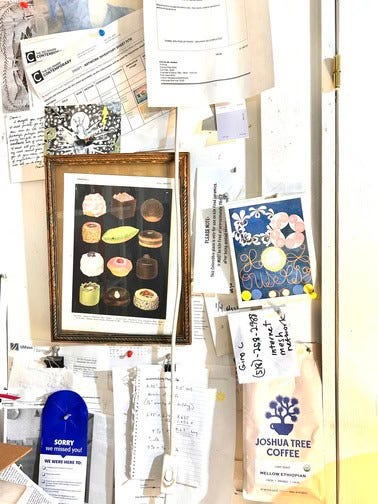
The inspiration for this issue came during a visit to Dana Sherwood‘s studio. The moment I saw a framed vintage cake illustration on her bulletin board, I knew I wanted to focus on the role of cake in her work. Sherwood understands what my mother couldn’t: we don’t need to eat cake to survive, but psychologically, it’s vital to have pleasure.
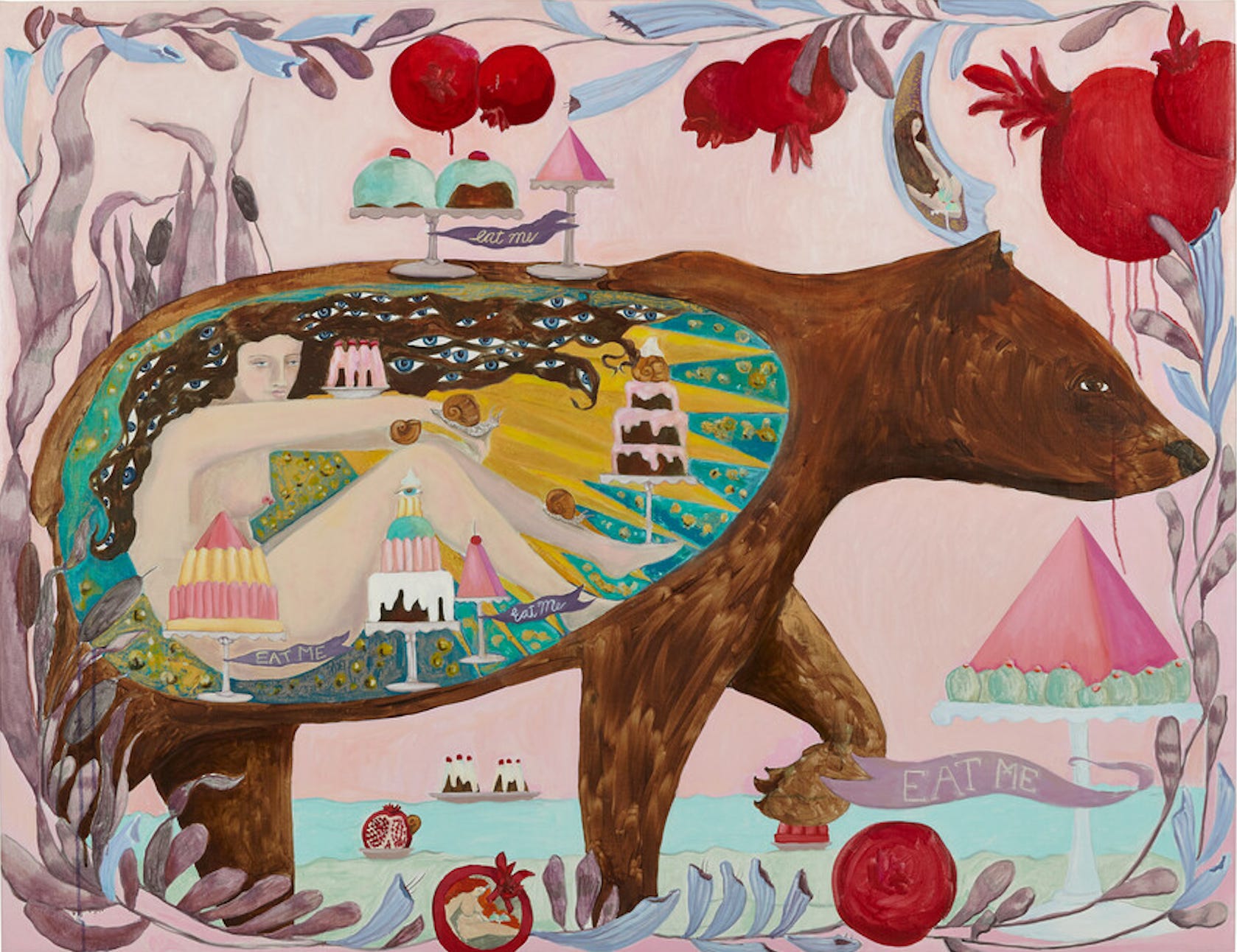
Eyes of Horus. Serpents. Pomegranates. And cake.
When I first noticed these recurring motifs in Sherwood’s paintings, sculptures, and videos, I couldn’t imagine how cake could match the power of such culturally significant symbols. But I was wrong. Sherwood weaves her cakes into fairy tale, mythological, and imaginary realms, imbuing them with unexpected meaning.
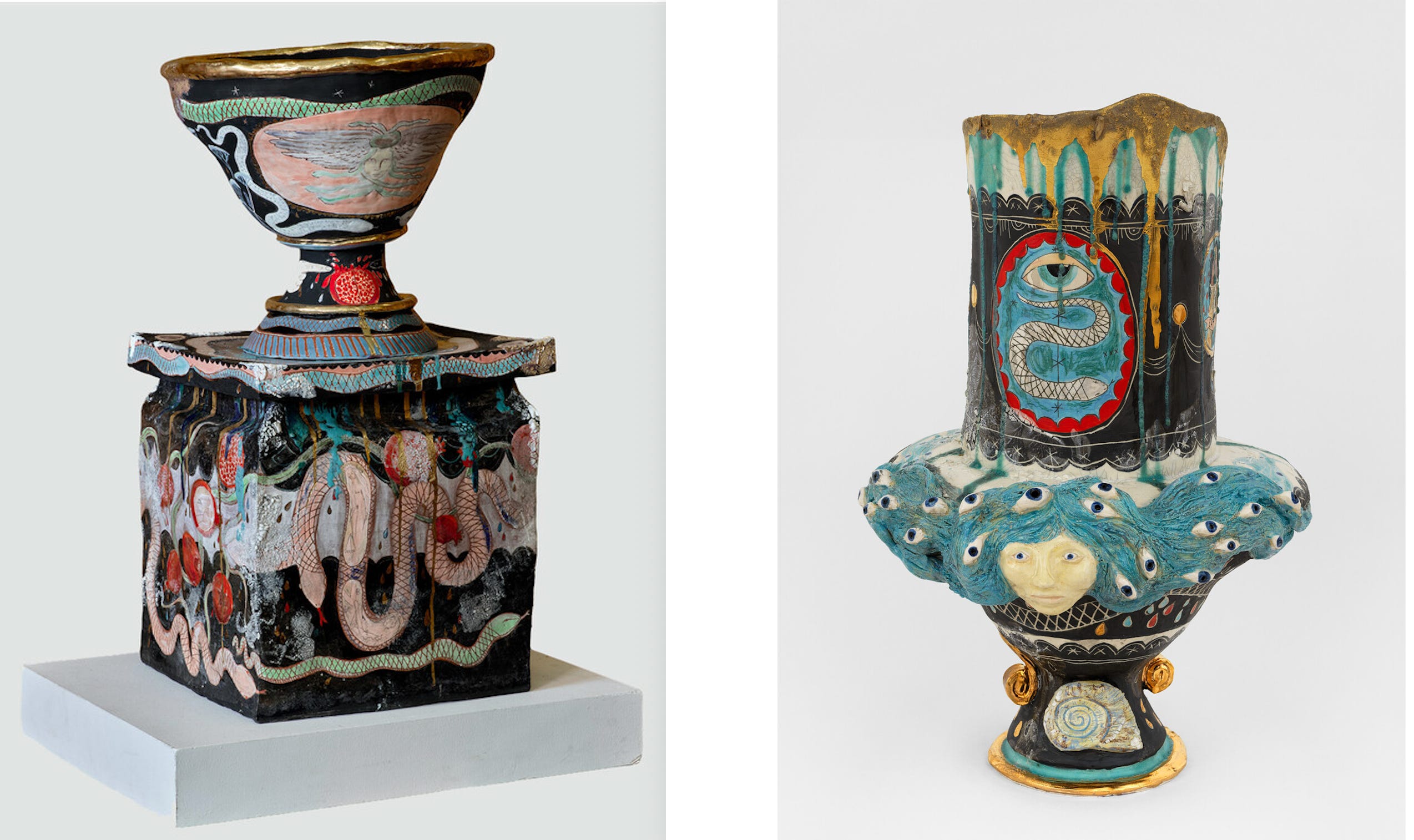
Her cakes recall architectural confections in the style of 19th-century European gâteaux — pyramids, swirls, or lady-finger-lined charlottes. These shapes and forms influence how Sherwood crafts her ceramics; when I look at her chalices and vases, the stacked components remind me of tiered cakes. For Sherwood, cake is sculpture first, food second.
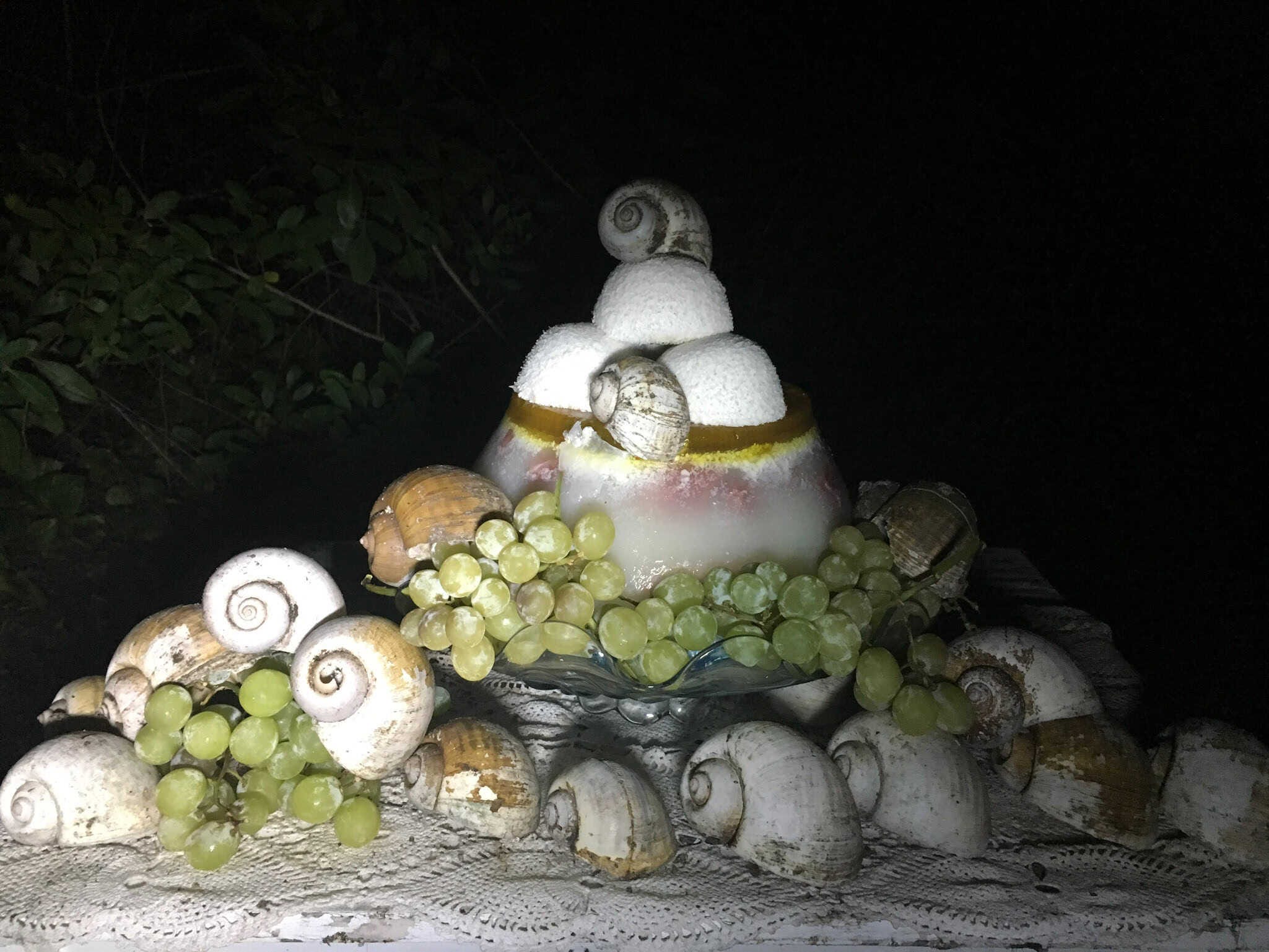
Sherwood recognizes that cake is both special and unnecessary: “When I paint food, it’s cakes. It’s not like a turkey dinner.” She loves cake’s fairy tale qualities and the power inherent in its presentation—especially when it’s on a decorative pedestal.
In fieldwork videos such as Feral Cakes, Sherwood creates nocturnal banquets to explore communication with animals. But she doesn’t just put out food—she develops cake recipes using animal-friendly ingredients and presents her confections in elaborately designed tableaux. For Sherwood, whether the recipient is animal or human, cake has special power: “There is a magic about cake, almost as though the ceremony of the cake creates a kind of liminal space of joy, laughter, and sometimes abandon.
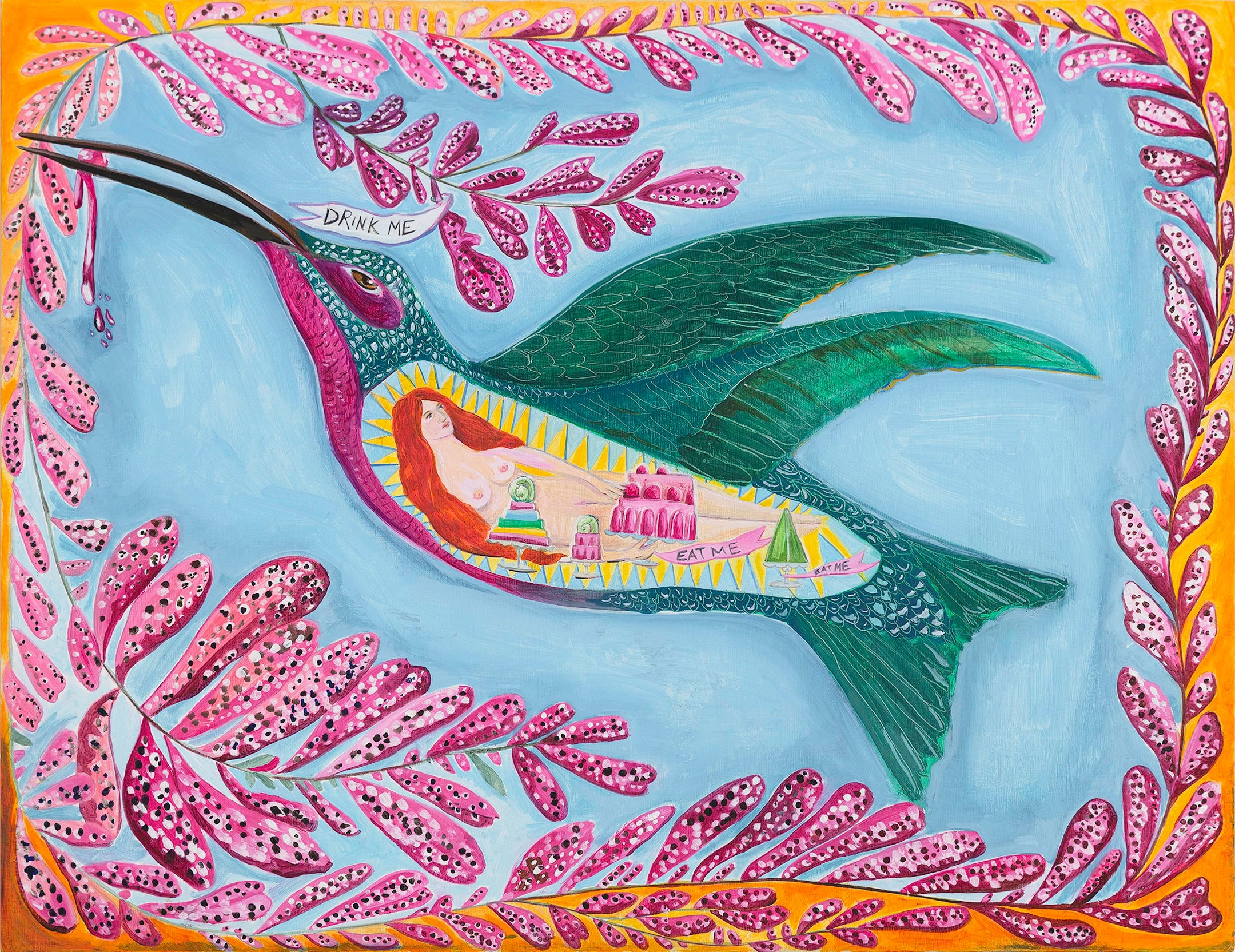
In Sherwood’s paintings, cakes create moments that “take you out of ordinary time” and become portals to other realms. Just as Persephone becomes bound to the underworld the moment she eats six pomegranate seeds, the “EAT ME” currant cake enlarges a shrunken Alice so she can reach the key to Wonderland’s garden.
Sherwood views Persephone and Alice as underworld heroines whose stories capture descents with no light to guide them. “These young women must find their way through the darkness, using their own intuition and resourcefulness.” For Sherwood, they mirror the artist’s journey: they must become their own authority, charting a path when none exists.
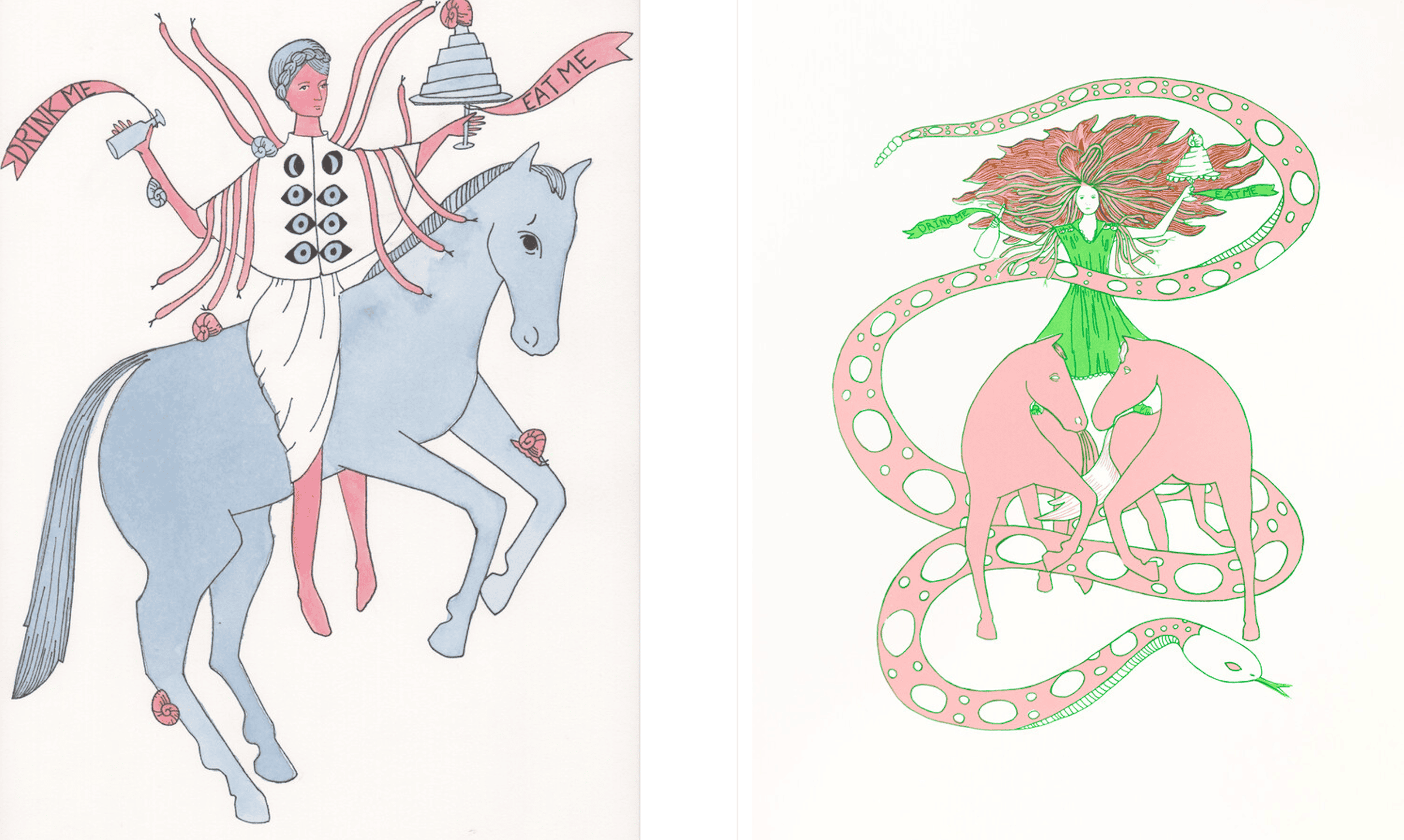
In Sherwood’s equestrian paintings, cakes become symbols of feminine power. Women astride horses proudly present cakes on pedestals, evoking triumphant warriors returning from battle. These are Sherwood’s version of “the ubiquitous equestrian statue, in which cultures worldwide have celebrated the male domination over nature and civilization.” Rather than wielding a sword or carrying the head of a vanquished soldier, Sherwood’s heroines come bearing cake—a feminine symbol. By subverting the image of the conquering hero and portraying femininity itself as a source of strength, Sherwood offers her vision of a heroine’s journey.
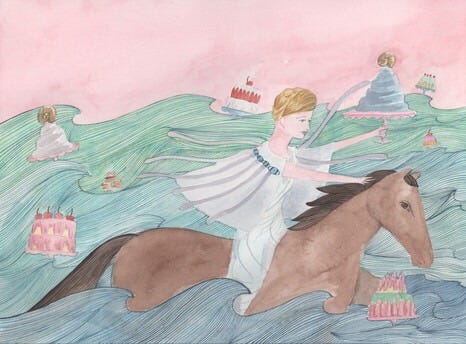
A new series centering on cakes emerged while Sherwood was working on her nocturnal videos. She began to think about secretive eating and indulging when no one was watching: “Women are programmed to watch what and how they eat. The messages received are damaging, and it makes one appreciate the way wild animals offer an alternative that is more instinctual, a more intuitive way of being in the world.”
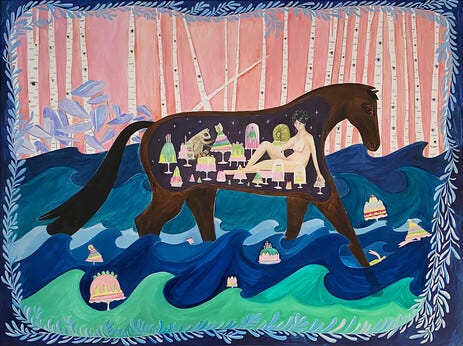
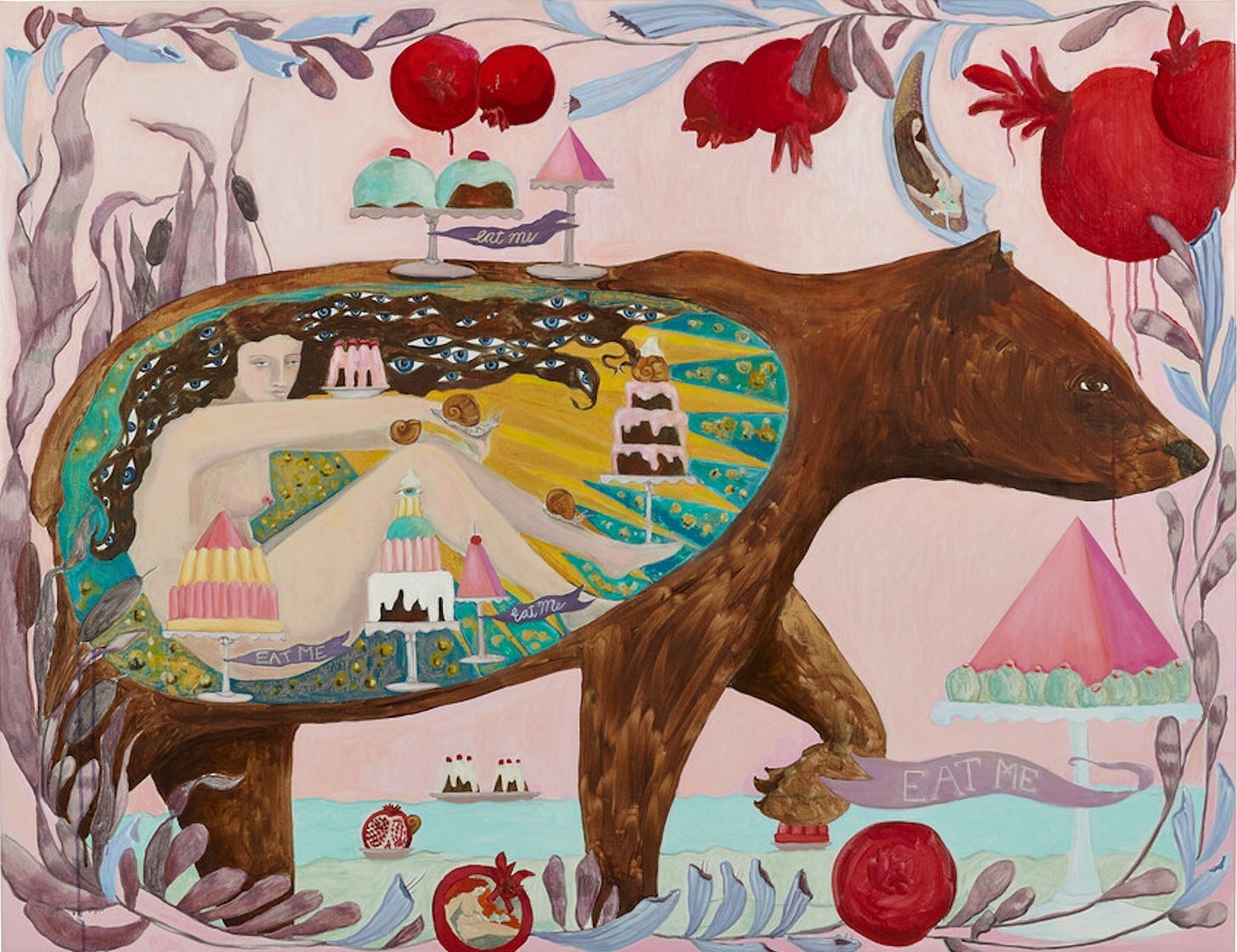
At the same time, Sherwood was “looking for a way to have a silent conversation, energetically, with horses.” This led her to ask: “What if I didn’t have a human mother? What if I had a horse mother?” As she began to imagine what it would mean to be nurtured inside a horse, her mind went to the “forbidden fruits of decadent desserts and confections and cakes that we don’t regularly allow ourselves to eat.” Here was my mother’s fear. Here were my bowls of batter hidden in the closet. Here, too, were alternative maternal figures creating a space for women to make peace with forbidden food.
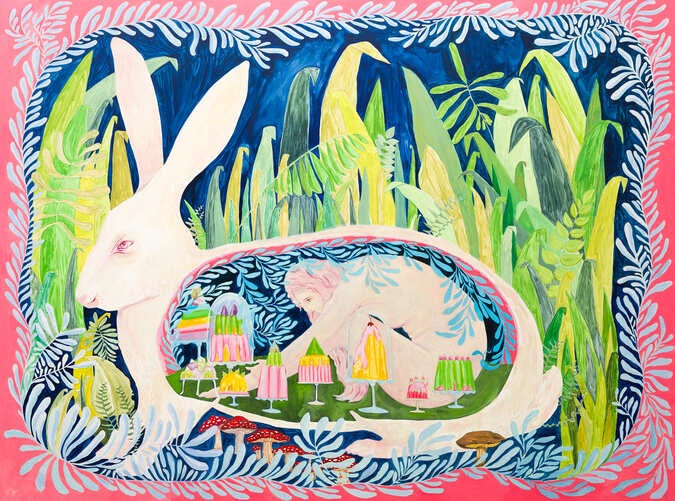
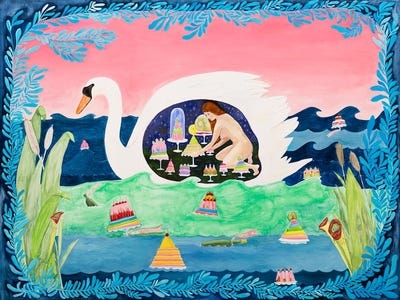
Sherwood expanded the series to include the bellies of a range of animals. Naked with their hair flowing free, her women are at home in these womb-like spaces. Rather than proffering cakes, the women receive them. Sherwood explains why their journeys are now complete: “They recognize themselves as animals, as part of nature and belonging to the shadows and the chaos, seeing it as their home. When they learn to see in the dark, they find that, in fact, they are surrounded by cake.”
Great piece. Great connections. Really moving how you connected your personal experience with these artists. Further proof that we are all interconnected and can help heal each other.
This was a wonderful read, Maggie! Really thought-provoking! Loved it🎂💕