ARTWRITE #35: Hands Touching Earth
Laura Moriarty
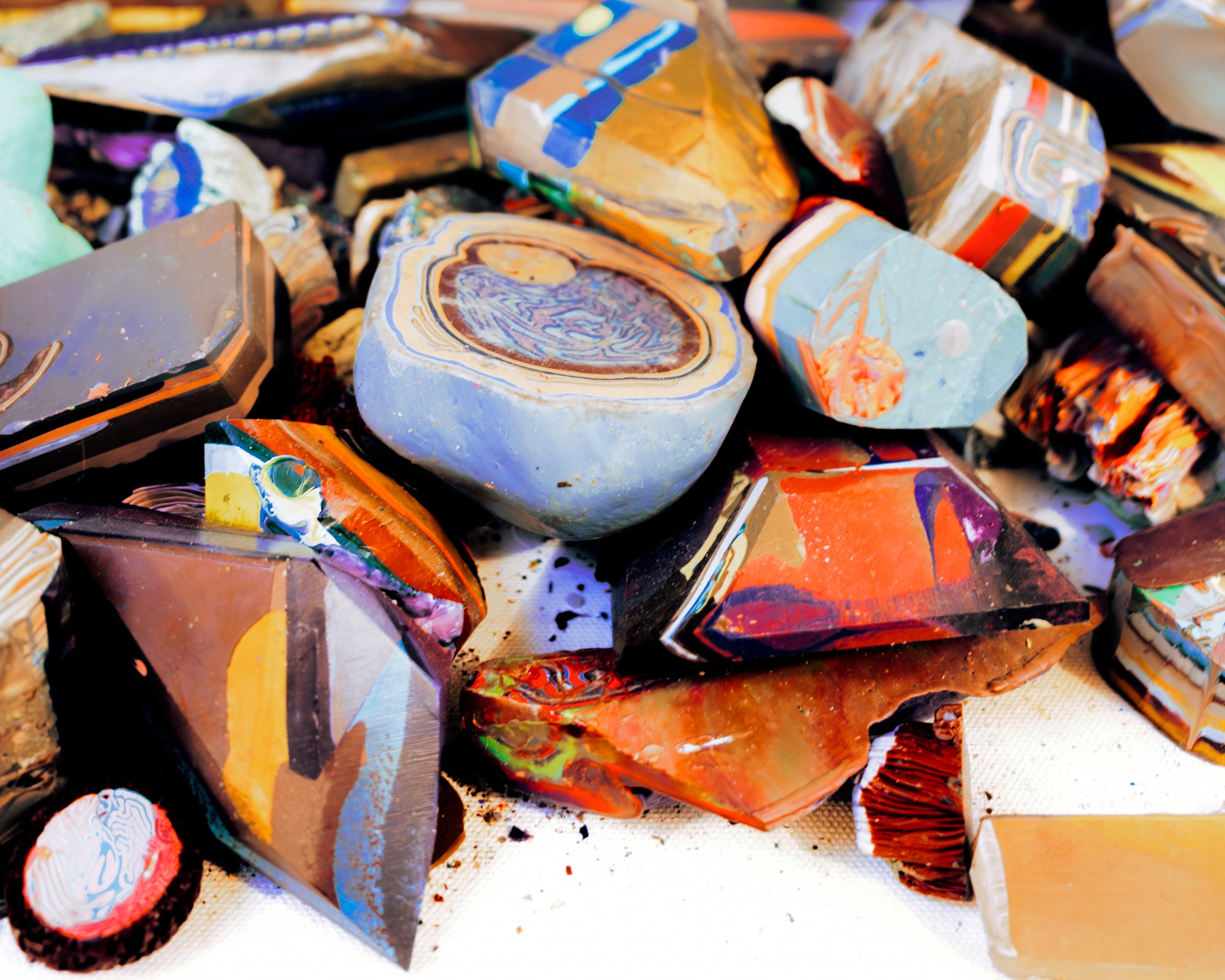
The first few times I visited artists in their studios, my fraud complex perked up. The artists would offer me a drink and point to a plate of cookies, and I’d inevitably think: this was a thing — something real art world people did. But I wasn't one of them. Eventually, I learned to trust that artists appreciated my genuine interest in their work. I began to relax and sometimes even ate a cookie
A few months ago, I drove to Laura Moriarty‘s studio in Kingston, NY, for FieldWork, a new quarterly print publication that celebrates the power of making. Laura’s work, layers of pigmented wax built up by hand and informed by the language of geology, was a natural fit for the second issue, “Hands Touching Earth.”
FieldWork’s editor insisted on giving me the freedom to respond to Laura’s work in any way that I chose — essay, poem, short story — even though I begged him to tell me what to write.
I watched interviews with Laura and read her book, Table of Contents, which uses a geology textbook as its conceptual framework. Once I understood how geology is at the heart of her paintings and sculptures, I assumed I’d make that the focus of my piece.
I’m obsessed with process (I’d rather be backstage, on a set, or at a rehearsal than sitting in the audience), so I requested to watch Laura at work – a first for me as I’d never watched an artist in the act of making.
As soon as I started observing Laura, I knew I was on the wrong track. She was not using a brush to apply paint to a canvas. There wasn’t even a brush.
Laura’s encaustic process includes multiple steps of her own invention, making it impossible to look at her work and visualize how it was made. Her intimacy with wax — knowing how it reacts to heat while also surrendering to it — fascinated me. I needed to put readers in the room with me.
As FieldWork is only available in print, I’m publishing my piece here along with Cedric Gairard’s photos for FieldWork, taken during a separate visit to Laura’s studio.
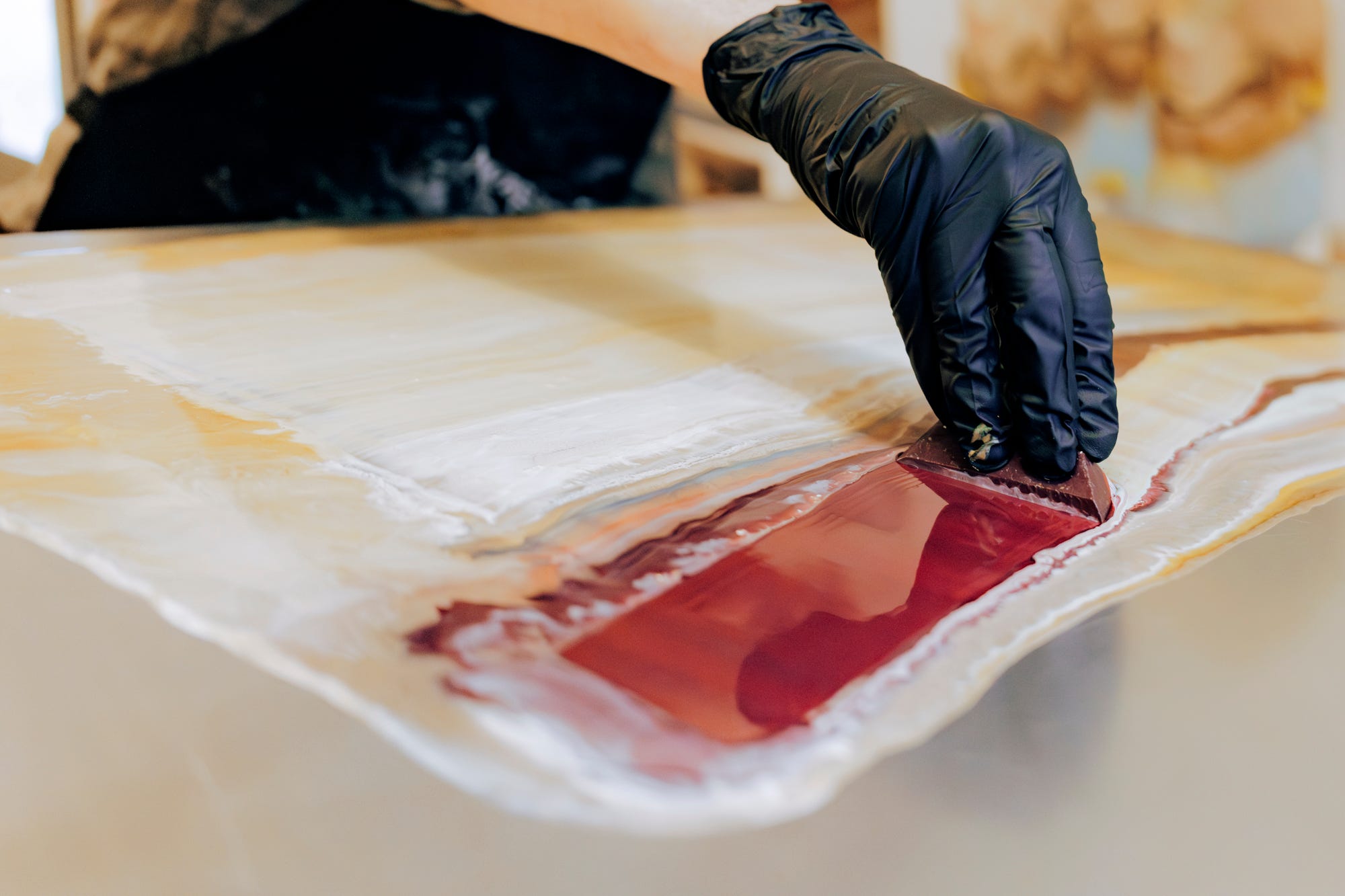
LAURA MORIARTY’s hand coaxes a beveled hunk of beeswax “like a squeegee” over a table-sized steel palette in her Kingston, NY studio. “I try to make myself go the same speed as the material.” Each pass over the heated surface leaves a wide mustardy-orange stripe on the steel.
Switching to a narrow wedge, Laura drags a stream of magenta striated with grey and white through a mustard wave. “So it’s time and temperature. Go really slow, and it’ll puddle,” she says, drawing out her words to match her pace. “You can also speed up, and it thins out,” she adds with a decisive swipe.
The wax pieces Laura paints with are both medium and tool — one-of-a-kind objects, unlike pencils, charcoal, or conté. She makes each one herself, layering colors and embedding fragments from one into another. As they meet the heated surface and flatten, their beveled edges reveal buried patterns and entwined colors.
A streak of white ripples through the magenta.
“How much of this technique is your own invention?”
“The whole process.” The angle of Laura’s wrist changes, and her wave crests become sharper. “It took about ten years of experimentation to get to this.”
“So, every piece is related to every piece?”
“They’re like journals for me. Some of them go back almost 30 years. I don’t expect other people to see that, but I do.”
“That makes me think sourdough, feeding the starter. It’s cumulative.”
“To me it’s a story of story, the fact that I’m adding to them as I go. They’re built up — chapter, foundation layers, first floor, second floor — things you aren’t quite capable of erasing.”
She moves to a nearby table covered with forms — stumps, slabs, blocks, a tablet. “So, the studio is set up as a mini, kind of tongue-in-cheek example of the rock cycle where I don’t throw anything away. If we were to clear this off, which I do around the edges all the time, you’d see that all this debris collects underneath because it’s all breaking down. At a certain point, I decide I’m just going to clean up, and I pull out anything that could still be used, and categorize it all into pebbles and rocks, and even dust.”
“Are you creating colors, or is it more like discovering color?”
“I can think, okay, I’ve got a yellow and a blue. There should be great contrast, and then I pull it out, and that blue wasn’t warm enough. That yellow is turning to brown really fast. It’s not beautiful.”
“So in spite of all your years of doing this, nothing is a guarantee?”
“Well, because I’m making soup out of it. All the different pigments have their own characteristics. Some of them are kind of like colored butter. Others are gritty and don’t disperse the way you think they’re going to.”
Back at the palette, Laura says, “Sometimes I get asked to do commissions, and it always makes me nervous because nothing I do can be repeated.”
“Who decides the colors?”
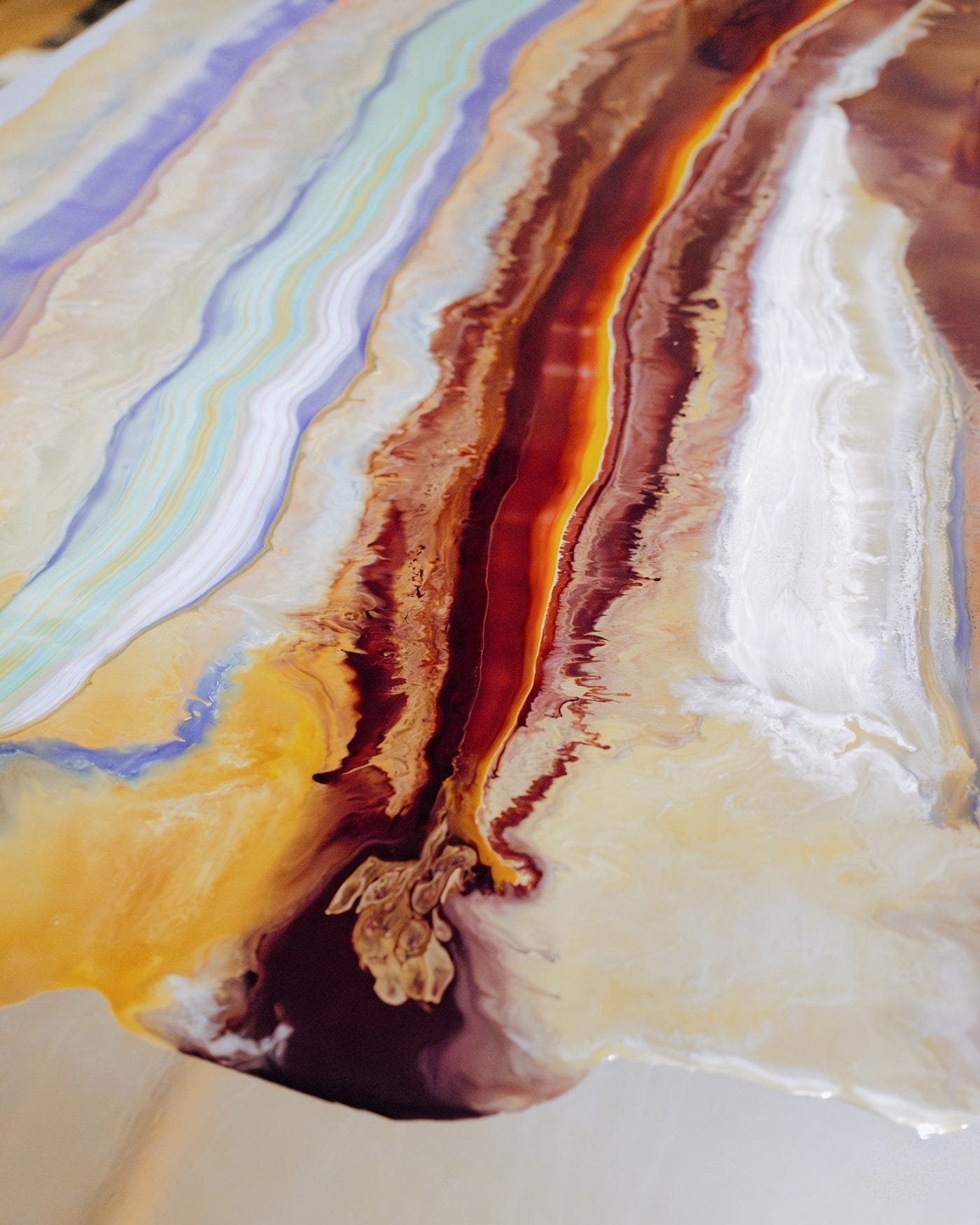
“I ask them for swatches — colors and textures. I want to know the texture. It gives you a certain set of limitations, which I like. I like having some kind of reference and stepping-off point that has nothing to do with me or my taste. That’s kind of why I turned to geology — it was this bottomless pit of metaphor.”
As she nudges a red and grey flecked dowel with her fingers, Laura seems to know exactly what it will do, whereas I never could have predicted what I see: undulating clay red and pigeony grey bands veined with ochre and teal.
Stepping back, she surveys her work. “Look at the flood zone here.” She points to where the last pass overlaps with the one before. “That’s where they’re most liquid and pushing against each other. They usually activate each other in an interesting way.”
I notice blue-black seeping into the clay red. “I see it! It’s moving on its own!” The paint shines like shellac and catches the reflection of a light bulb.
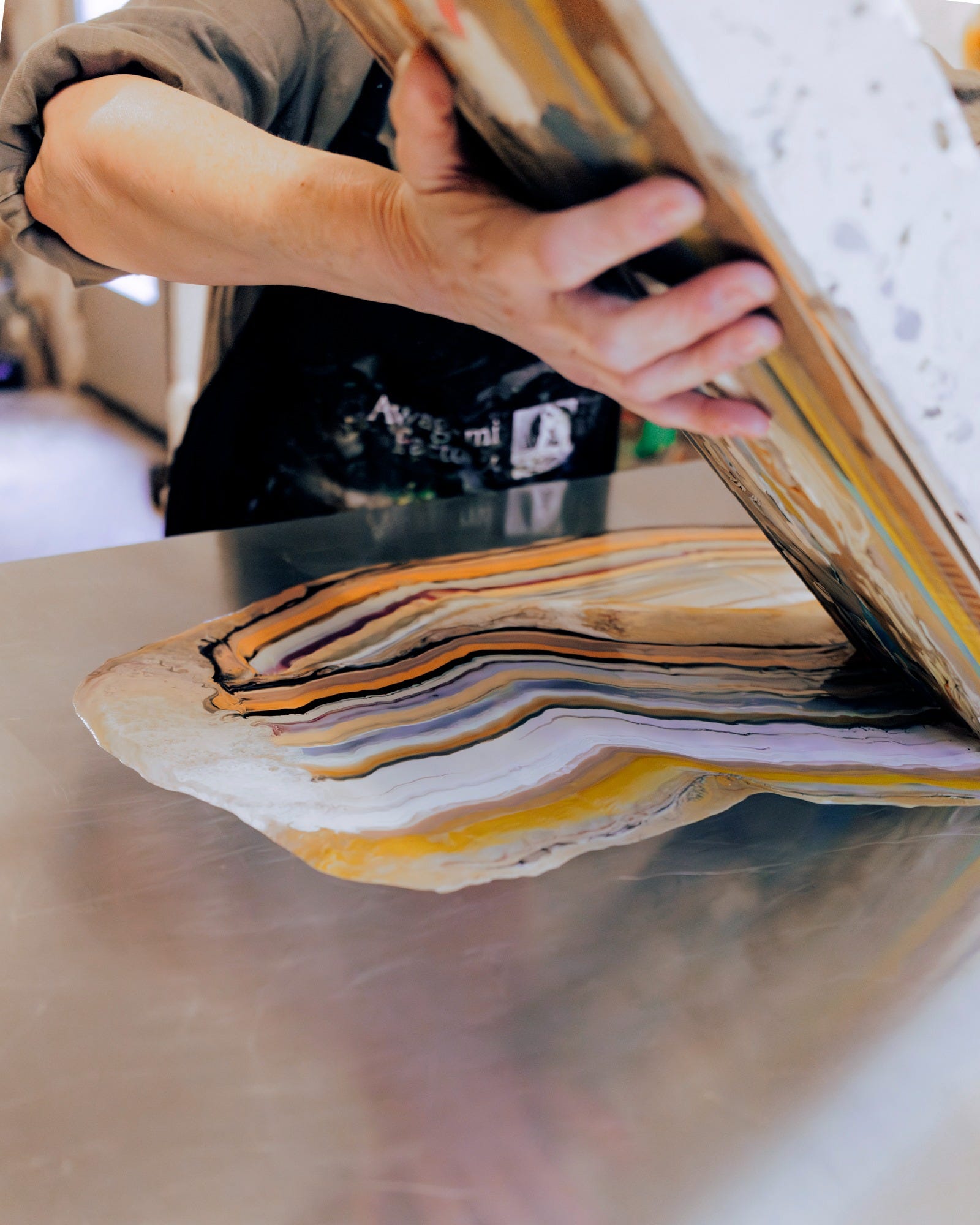
“Sometimes it’ll move so much it gets kind of dull, or all the details blend into each other, so you have to get the paper ready.” From a rack, she pulls out a poster-sized sheet of translucent white paper. It’s Kozo, made from Japanese mulberry.
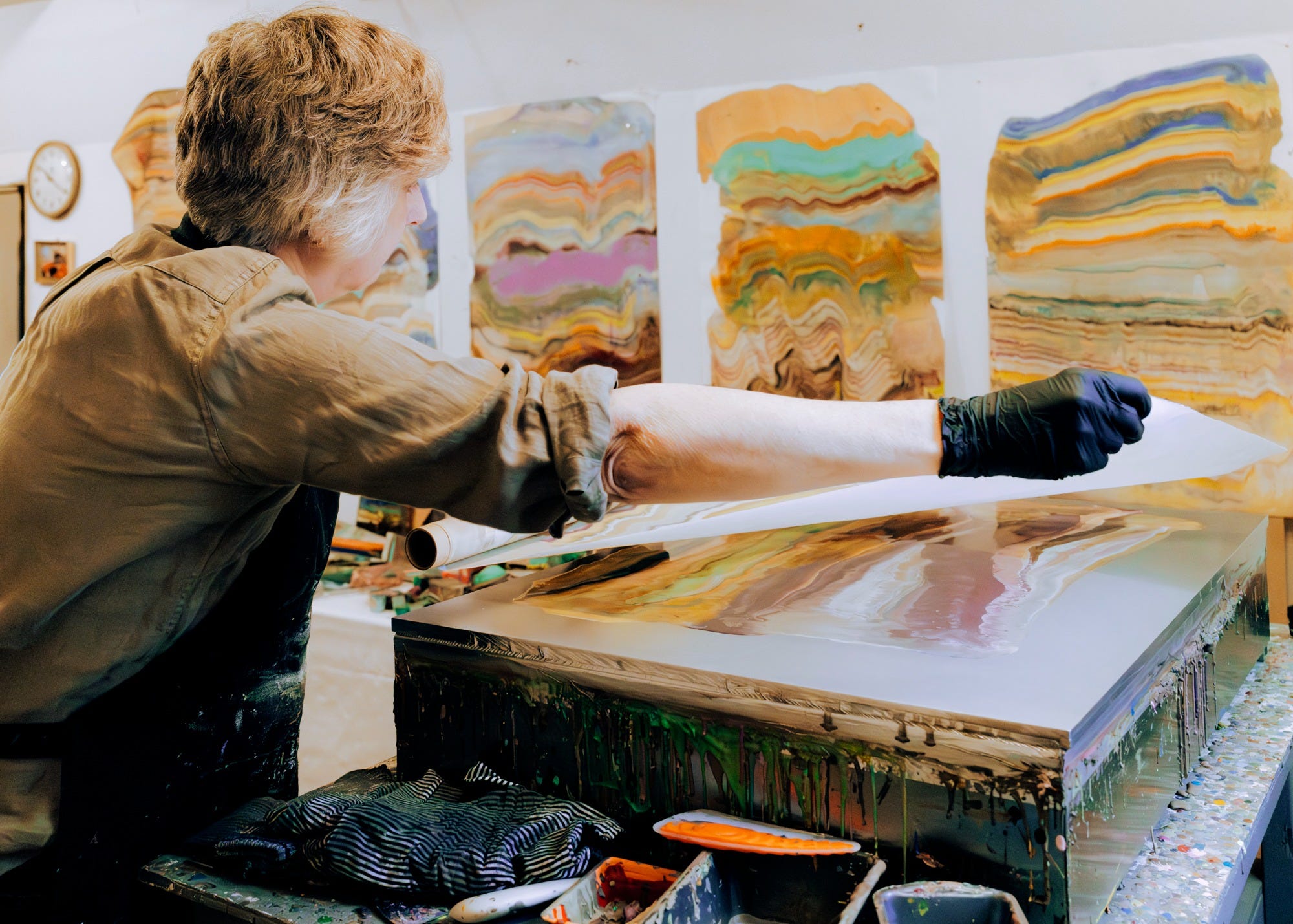
In one motion, Laura places the top half of the sheet over the paint. The image unfurls from top to bottom. “Oh my God,” I say over and over, whispering so I won’t interrupt the process. In 12 seconds, the fibers have drunk up everything but the thin section where Laura sped up.
After she removes the paper, a shadow of the painting remains on the surface. Using a silicone scraper, she pushes the residual paint into her “sludgepot” before laying down new colors.
“I’m gonna try to land that open area on that top blue line,” she says as she reaches for a cardboard tube. Rolling up the top of the paper, she positions the open area over the hot surface. We lean over and watch a bluish black creep into the white space. “Geronimo!”
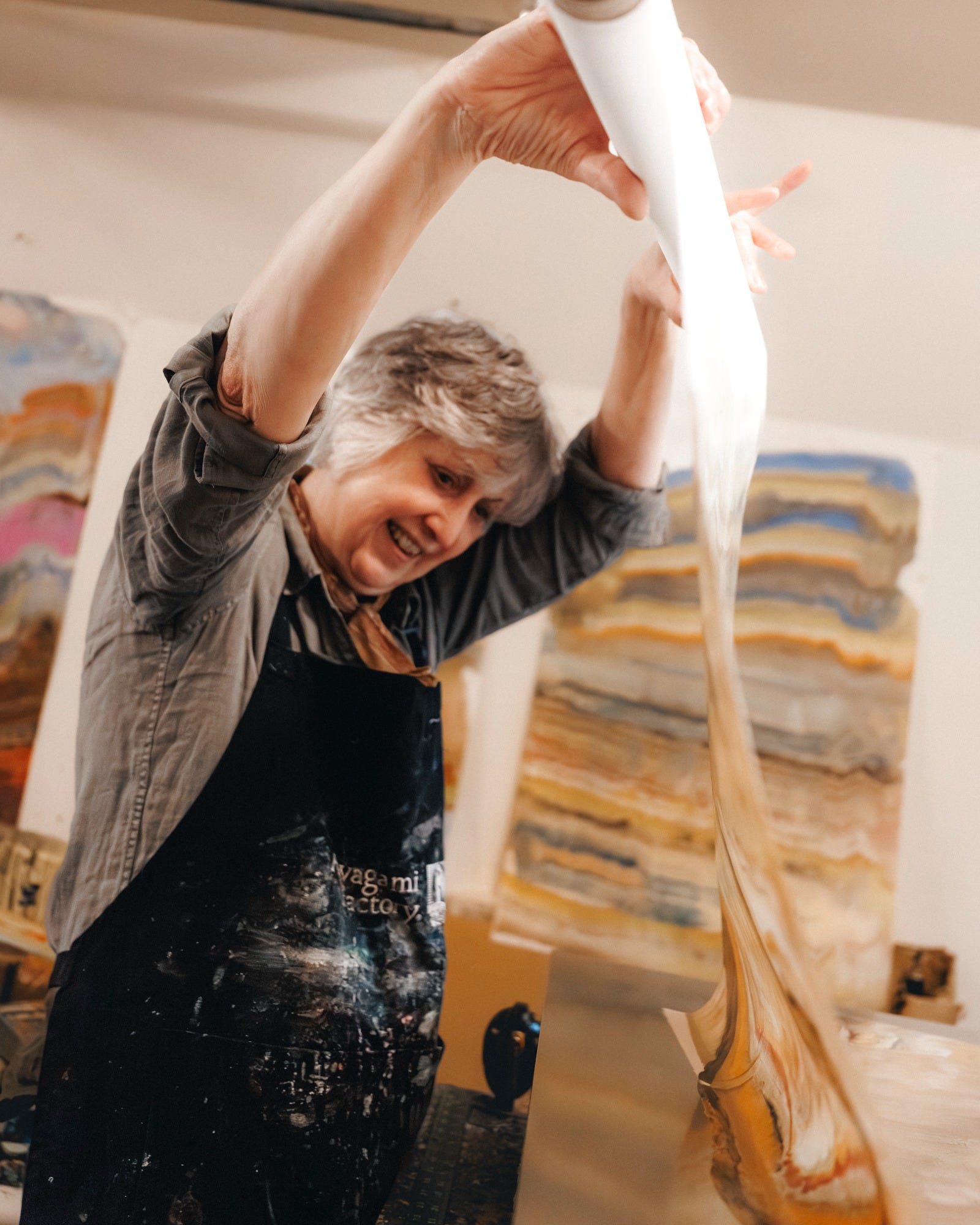
Pinching the corners of the paper, she peels it off in slow motion. “You’re gonna see all these little bubbles pop. And they leave little marks like fossils. At the right temperature, it makes a beautiful mark as the wax flows down the paper. You see the gravitational pull of it.”
“Like a tide.”
“Yes.” She lays the painting down to dry. “It leaves some of the debris behind.”
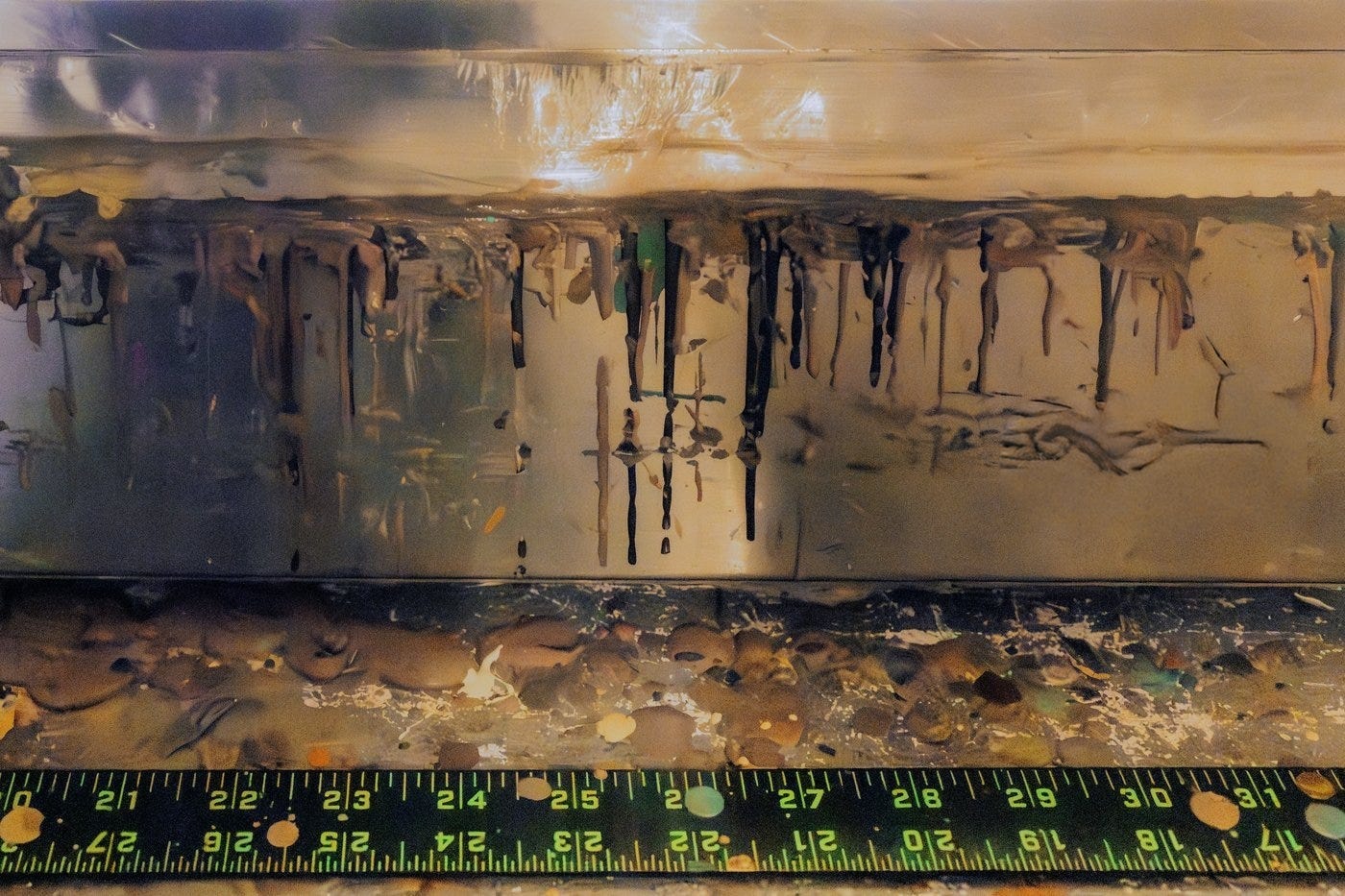
Colored drips of wax hang from the edges of the palette. Laura wipes the surface down with a rag and turns off the heat.
Shelves along the wall are filled with sculptural objects: geodes with maze-like designs, flints, and architectural forms in saturated colors. Some rest on a copy of Evolution of the Earth.
“For me, this is an intellectual activity. I’m brave enough to say it’s my spirituality. This is the most important thing that I do. And I do it because I have this reverence for something that I’m working at. A culture I’m making a contribution to. Not that I’m above it, or beyond — again, I get into that thing where we’re in it.”
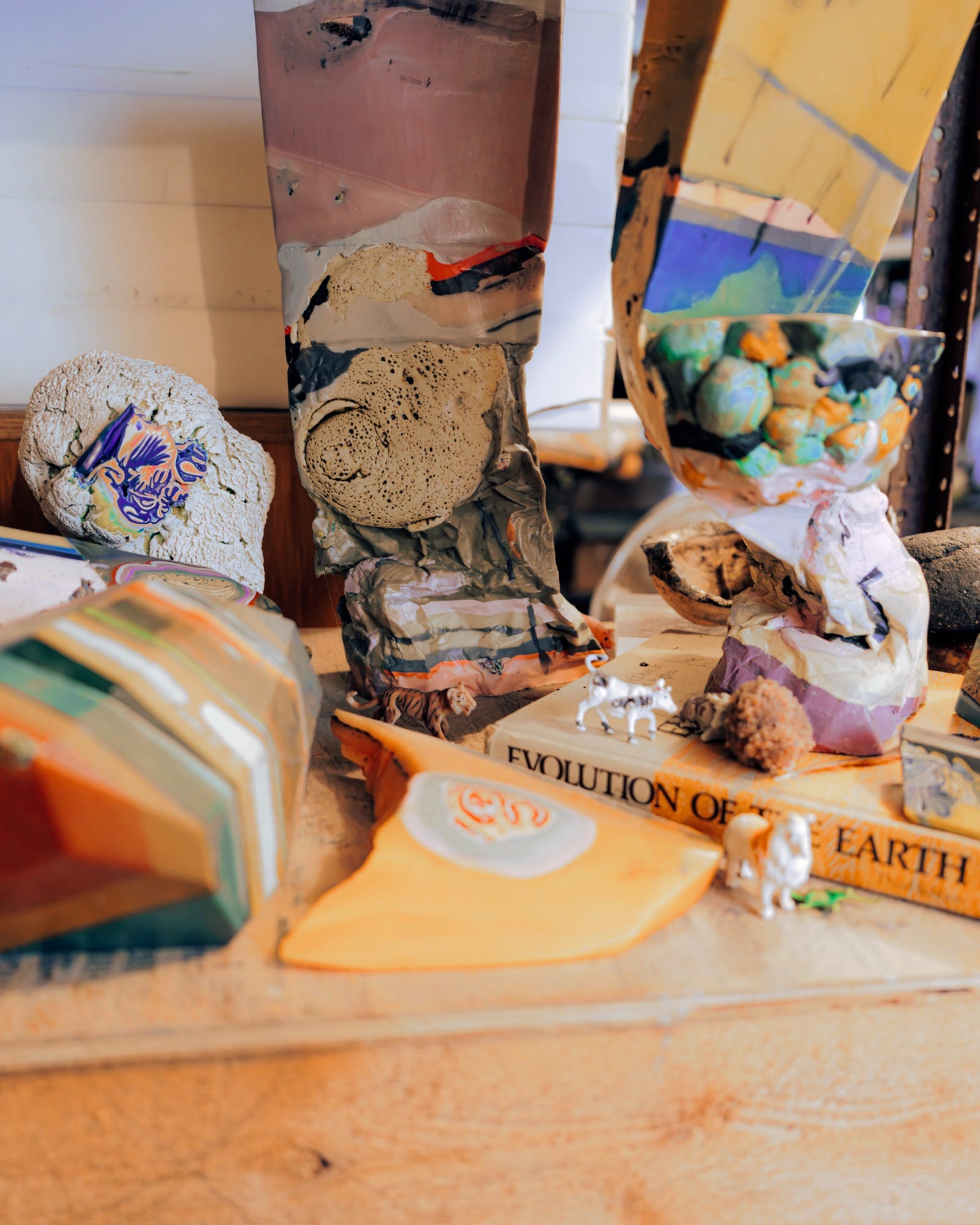
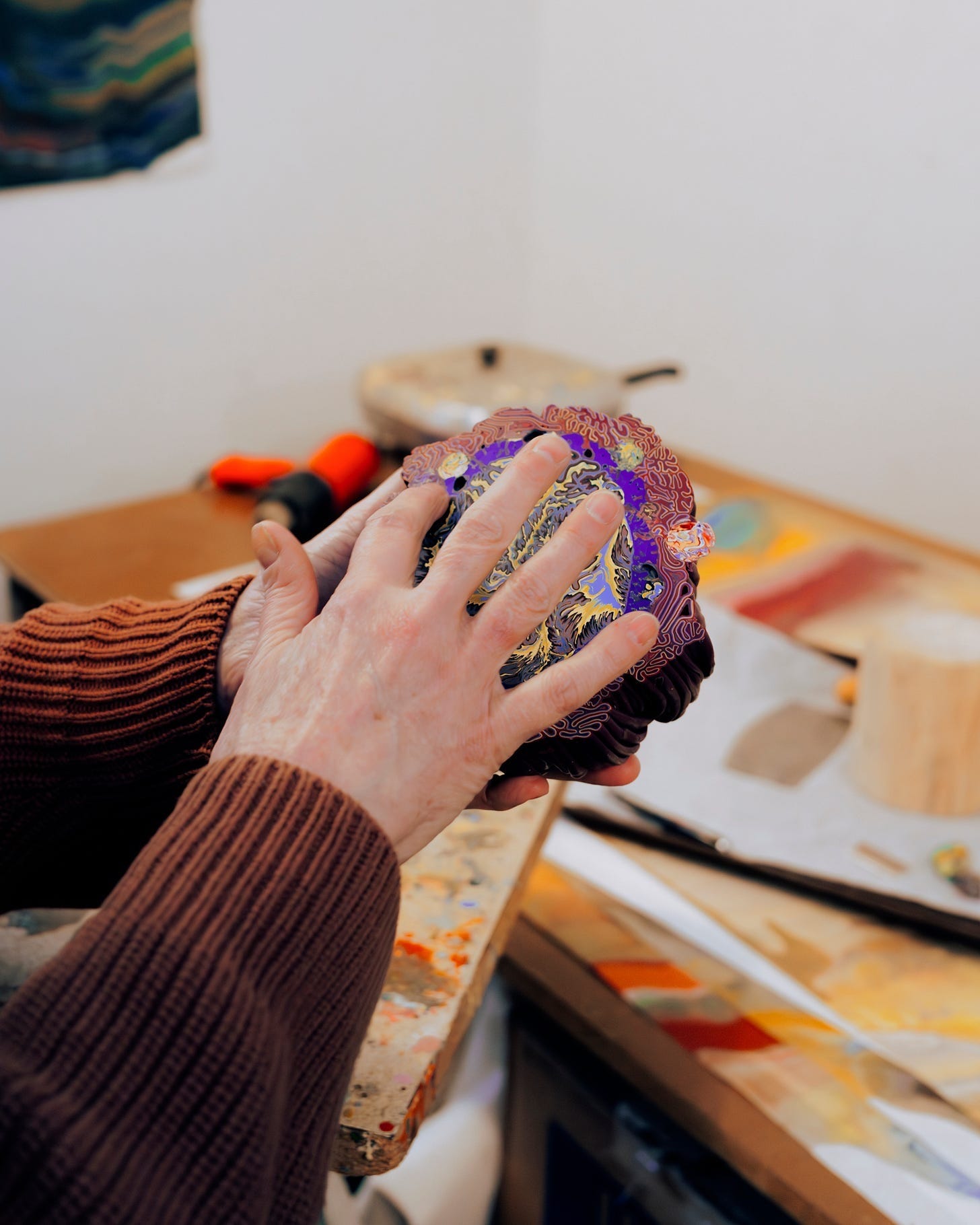
I pick up a cube — some edges rounded, others sharp. Stripes of cobalt, lilac, russet, black, sky blue. On one facet, clusters of coral remind me of Matisse cut-outs. On another, concentric circles of unexpected combinations of colors surround a mandala. I feel like I’m holding a talisman.
I point to tiny flecks sparkling beneath the smooth surface. “Is that gold?”
“Yes, I love gold. I use metallic paint. It has some mica in it.”
“This is a whole other technique you’ve created, too?”
“It’s all part of the same thing. It just evolves. But I really love when you can get so deep into the piece that you’re no longer controlling. It’s like, whoa, what was the paint doing in there, crashing off and moving around together?”
“I don’t want to put it down.”
“Yeah.” Laura laughs. “I like that one too.”
“I feel like if somebody goes into a gallery and falls in love with one of these pieces, they’ll have their own experience of it. But once you know how you made it, it gives it this whole other dimension.”
I turn the cube over. A tiny rectangle swirls white on blue like Earth from space. I turn it again.
“It’s more than showing how it’s unique. What it does is make people feel like, ‘I know this.’ There’s a recognition because the things that are inspiring to me, you see. You see what it is, and you say, ‘I know that moment that happened. It was really exciting, and it looks beautiful.’”
Fabulous report and artistical work ! 👏
great article! great to know about Laura